
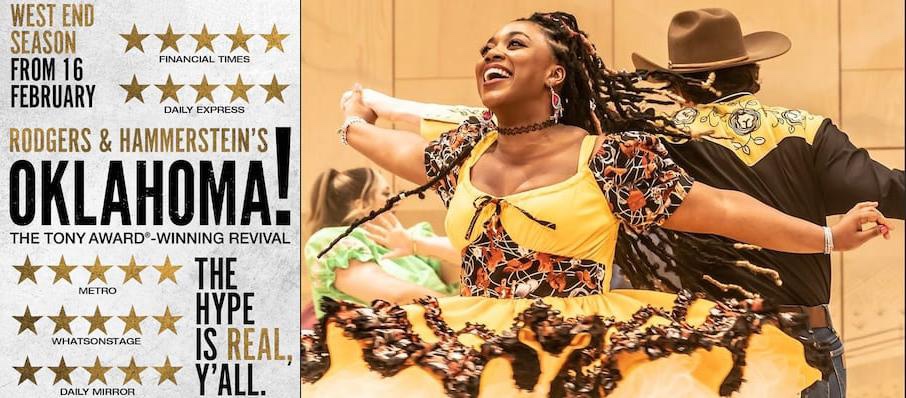
We open on a set festooned with rifles, and with a battery of spotlights supplementing Wyndham’s houselights, and cooking the backs of the necks of the folk in the cheap seats in the top circle. And they are on for most of the show. And they make no sense. Just to deal with the lighting for a moment – because it was unusually awful and because it hasn’t been skewered enough…. Theatre lights have a job to do, illuminating the action and the actors’ faces and bodies. With several notable exceptions they did that. The lights can also help direct attention – a glaring general cover on a stage littered by the entire cast wasn’t much help there. The lights can also set mood. Weird green washes, weird red washes, neither seemingly having much to do with the song or the scene; relentless glare across the audience that didn’t seem particularly purposed. The beating Oklahoma sun, maybe? In the IKEA decorated office of the Oklahoma NRA? The mood they mostly set was a bad one. They did have blackouts. Total blackouts, no exit sign lights, nothing, and then a wibbly-wobbly hand-held camera fixes images of a sweaty Jud Fry and a very sinister Curly McClain onto chunks of architecture. It was easy enough to see huge eyes and heavily emphasised noses, but Wyndham’s plaster-cherub-tastic fixtures rendered the picture fairly indistinct. Creepy, though. Everything was creepy. The lighting designer Scott Zielinski made that happen. And Laurey gets to chose between the evidently psychotic Jud Fry and the leeringly abusive Curly. Some choice. Those pioneer women had it tough.
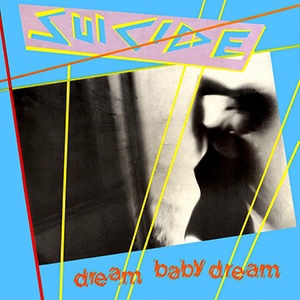
This is high-concept theatre at its very worst. The whole cast on stage for no reason, except when they walked off for no reason; the blazing lights; the elimination of charm or hope from some very bright and breezy songs – it seemed like the director Daniel Fish suddenly spotted that Jud Fry is a weird, threatening, potentially evil character in the background and decided to put him in the foreground. Curly goes into the pitch-black shack where Jud lives and encourages him to hang himself with his own lariat, it’s that sort of show. Mr. Fish seems to think no-one has ever noticed that aspect of Oklahoma, but Rod Steiger was powerfully weird in the 1955 movie. Not filmed-in-black-and-white-with-a-camera-up-his-nose weird, but weird enough. The very worst aspect of a terrible evening in a theatre came at the opening of the second act, the dream ballet. Anna Maria de Freitas seems to be an excellent dancer, required by (I assume) associate choreographer Shelby Williams, since it wasn’t the way the original choreographer Agnes de Mille visualised it, to caper around the stage in a sparkly dress labelled “Dream Baby, dream..” An homage to the greatest hit by Alan Vega’s punk duo Suicide? Who knows? She gets rained on by cowboy boots. Why? Who knows? The boots get cleared off the stage by the Jud Fry actor Patrick Vaill, in the least ept, least elegant piece of stage-craft ever seen in Wyndham’s 124 year history, crawling after stray footwear and hurling it petulantly off-stage. Jud Fry is a man who hates boots?
The intentions of the production are obscure. The results are annoying, and soul-less, and depressing. This is a new way of looking at Oklahoma, but it is a miserable way. Re-stage all you want, Daniel Fish. Maybe next time re-stage with something resembling coherence? All the performers are fine, by the way. Occasionally some singing breaks out. And a man in the orchestra pit plays a pedal-steel guitar. I like pedal-steel guitars.

 thestarsshinestill.com